
Roofing Tips & Guides
Expert Roofing Advice for Charlotte Homeowners
Learn from Charlotte's trusted roofing experts. Tips on maintenance, repair, replacement, and protecting your home from the elements.
Leak or wind damage from Isaias? 24/7 emergency tarping, free storm-damage inspections and insurance-claim help.
Learn from Charlotte's trusted roofing experts. Tips on maintenance, repair, replacement, and protecting your home from the elements.
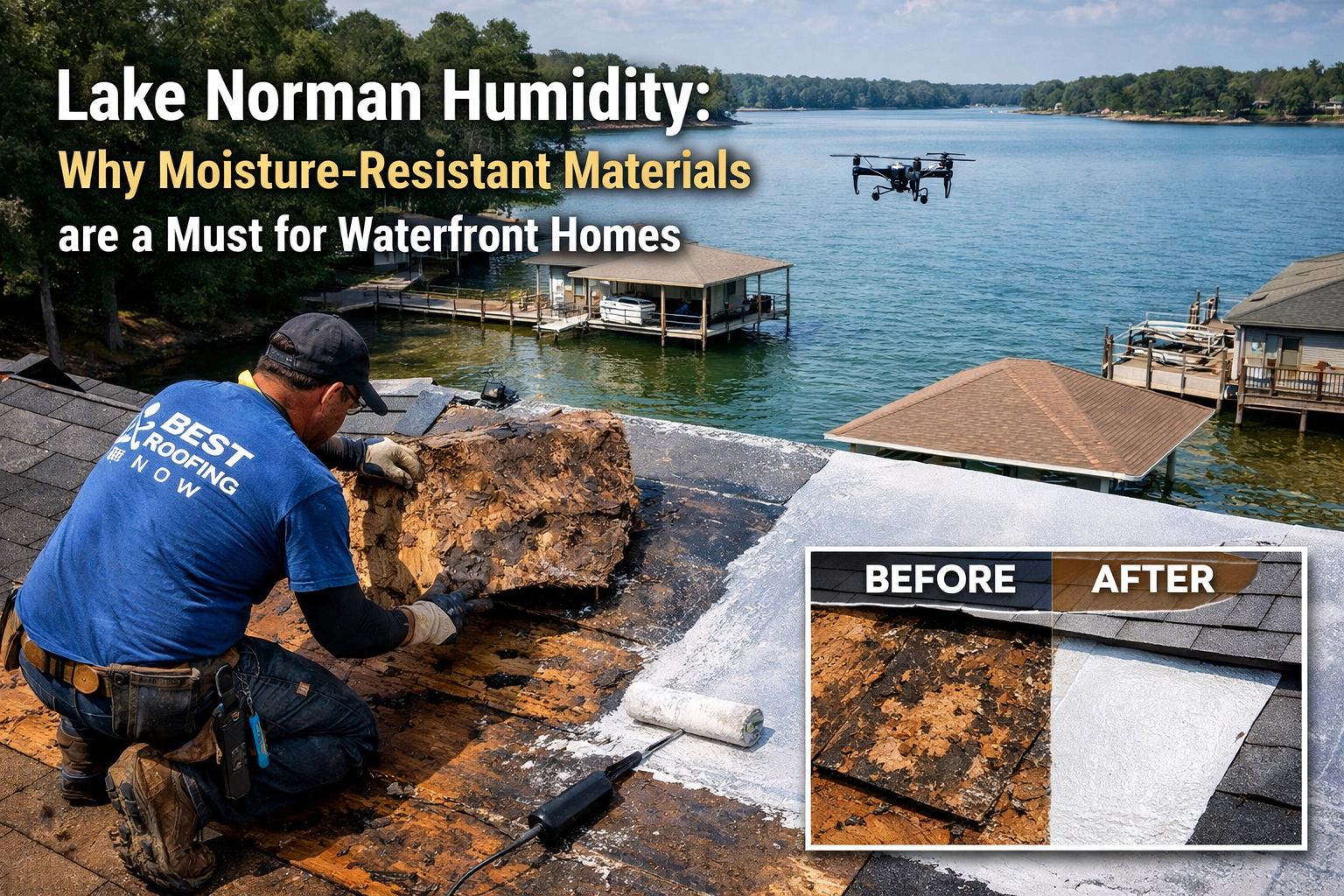
Living on Lake Norman is amazing. The sunsets over the water. The boat rides. The lifestyle that drew you here in the first place.
But that same waterfront location creates a roofing challenge most contractors won't tell you about.
The humidity coming off 32,510 acres of water doesn't just make summer afternoons feel sticky. It's actively working against your home every single day. And if your roof wasn't built with moisture resistance in mind, you're already fighting a losing battle.
I've replaced enough Lake Norman roofs to know the pattern. A homeowner calls about "a small leak." We get up there and find mold spreading through the attic. Sheathing that's gone soft. Insulation that's completely worthless.
The damage didn't happen overnight. It's been building for years while moisture quietly did its work.
Let me show you why waterfront homes need a completely different approach to roofing, and what actually protects your investment when you're living this close to the water.
Here's what makes Lake Norman different from other Charlotte neighborhoods.
The lake creates its own microclimate. Especially from May through September when humidity peaks. That massive body of water is constantly evaporating. The moisture rises. And it settles right into the homes around the shoreline.

We're talking about 45 inches of rain per year. Around 105 days of precipitation. And humidity levels that stay elevated even on "dry" days.
When I inspect roofs in Cornelius or Davidson, I see the difference immediately. Homes two miles from the water show normal wear patterns. Homes right on the lake? They age differently. Faster. The moisture accelerates everything.
And it's not just summer. Winter condensation creates its own problems. When warm air from your heated home meets cold roof decking, you get moisture accumulation. Over time, that leads to rot, mold, and structural damage you can't see until it's expensive.
The Lake Norman lifestyle comes with Lake Norman roofing challenges. That's just reality.
Most people think about water damage in terms of obvious leaks. A missing shingle. A storm. Something dramatic.
But humidity damage is sneaky. It happens slowly. Invisibly. Until one day you've got a serious problem.
Here's how it works.
Warm, humid air carries moisture. When that air gets into your attic (and it will), it condenses on cooler surfaces. Your roof decking. Your rafters. Your insulation.
That moisture creates the perfect environment for mold and mildew. These organisms don't need much. Just moisture, organic material (like wood), and time. They grow in the dark. Behind walls. Under insulation. Places you never look.
I've pulled back insulation in Lake Norman attics and found black mold covering entire sections of decking. The homeowner had no idea. No visible signs inside the house. But the damage was real and extensive.
Beyond mold, moisture causes wood rot. Your roof decking is plywood. Plywood is made from thin layers of wood glued together. When it stays wet, those layers separate. The wood gets soft. Eventually, it can't hold nails anymore.
We've had situations where we went to replace shingles and found the decking so rotted you could push your finger through it. That's not a shingle problem. That's a moisture problem that's been building for years.
Your HVAC system takes a hit too. High humidity makes your air conditioner work harder. It's not just cooling air, it's removing moisture. That extra workload shortens equipment life and drives up your energy bills.
All of this is preventable. But it requires the right materials and the right installation approach from day one.
I get it. Roofing is expensive. When you're getting quotes, it's tempting to go with the lowest number.
But here's what cheap roofing actually costs you on a waterfront property.
Standard roofing materials work fine in dry climates. They're designed for basic rain protection. But they're not engineered for constant high humidity exposure.
A budget contractor will use standard felt underlayment. It's cheap. It meets basic code requirements. And it will fail prematurely in high-moisture environments.
They'll skip moisture barriers where they're needed most. They'll use standard sheathing instead of moisture-resistant alternatives. They'll install minimal ventilation because it's faster.
Then three to five years later, you've got problems.
Maybe it's premature shingle failure. Shingles that should last 25 years are curling and cracking at year 10. Why? Because moisture from below is degrading the adhesive strips and damaging the mat.
Or it's mold remediation. Removing mold from an attic costs thousands. Sometimes tens of thousands if it's spread to living spaces. Your insurance might not cover it because it's "maintenance-related."
Or it's a full roof replacement decades earlier than expected. Because the decking failed and needs complete replacement.
I've seen homeowners spend $15,000 on roof replacement. Then another $8,000 on mold remediation. Then $5,000 on new insulation and ventilation improvements. All because the original installation saved $2,500 by skipping moisture-resistant materials.
That's not savings. That's just delayed expense with interest.
Let me tell you what we use on Lake Norman homes and why.
Moisture-resistant roof sheathing is the foundation. Standard plywood will work. But we prefer ZIP System sheathing or similar engineered products for waterfront properties. These materials are designed to handle moisture exposure. They have built-in moisture barriers. They don't delaminate when humidity gets high.
The cost difference is maybe 15% more than standard sheathing. But the performance difference is massive over the life of your roof.
Synthetic underlayment instead of felt paper. Traditional felt breaks down faster in humid conditions. Synthetic products like GAF Deck-Armor or similar are waterproof, breathable, and don't deteriorate. They create a secondary moisture barrier that protects your decking even if shingles fail.
We install this on every Lake Norman project. No exceptions.
Ice and water shield in critical areas. This is a sticky, waterproof membrane. We use it in valleys, around chimneys, at roof penetrations, and along eaves. It seals around nail penetrations automatically. One of the best moisture protection materials ever invented.

Proper ridge ventilation paired with soffit vents. This creates airflow through your attic. Moving air prevents moisture accumulation. We calculate the exact amount of ventilation needed based on your attic size and design.
Ventilation isn't optional on a waterfront home. It's essential.
Quality flashing systems at every transition point. Where your roof meets a wall. Around chimneys. At dormers. These are the spots where water finds a way in. We use corrosion-resistant metals and proper installation techniques that create overlapping barriers.
I can't tell you how many Lake Norman roofs I've seen with beautiful shingles and failing flashings. The flashings are where the battle is won or lost.
Moisture-resistant insulation when we're doing full replacements. Closed-cell spray foam in certain applications. Properly faced batt insulation with vapor barriers on the correct side. Insulation strategy matters in humid climates.
These materials cost more upfront. But they're engineered for exactly the conditions your roof faces every day.
If you bought a home on Lake Norman, you're not dealing with average Charlotte conditions.
You're getting direct moisture exposure from the water. You're getting higher humidity year-round. You're getting more severe temperature swings between day and night (water moderates temperature, creating bigger differentials between your roof surface and the air below).
Your roof is working harder than a roof five miles inland. It needs to be built differently.
Think about it like this. You wouldn't use the same boat on Lake Norman that you'd use on a calm pond. Different conditions require different equipment.
Same with roofing.
We've done projects in Cornelius, Davidson, and Huntersville where the waterfront homes needed completely different material specifications than identical houses a mile inland.
The National Roofing Contractors Association recommends enhanced moisture protection for structures near large bodies of water. This isn't our opinion. It's industry best practice based on decades of performance data.
Your home deserves materials that match the environment it lives in.
Every Lake Norman home is different. The level of water exposure varies. Tree coverage matters. Roof pitch affects ventilation. The age of your home determines what's practical.
When we do a consultation, we're looking at your specific situation.
Is your home directly on the water or set back? Direct waterfront exposure gets our most aggressive moisture protection strategy.
What's your roof pitch? Low-slope roofs need extra attention because water doesn't shed as quickly. We might recommend different underlayment or additional ice and water shield coverage.
How much shade coverage do you have? Trees are beautiful. But they trap moisture and drop organic debris. A heavily shaded roof needs better ventilation and potentially algae-resistant shingles.
What's your attic ventilation situation right now? We calculate your net free ventilation area and compare it to code requirements. Most older Lake Norman homes are under-ventilated.
What's your budget and timeline? I'm not going to pretend cost doesn't matter. Sometimes we phase projects. Get the critical moisture protection in place now. Plan for additional improvements later.
This is why we don't do pressure sales. You can't make informed decisions about moisture-resistant materials when some guy is rushing you to sign a contract.
We measure. We calculate. We explain options. Then we let you decide what makes sense for your home and your budget.
Not every contractor thinks about moisture resistance. Especially the out-of-town crews that show up after storms.
Here's what to ask before you hire anyone.
"What type of underlayment do you use and why?" If they say "standard felt," they're not thinking about Lake Norman conditions. You want someone who specifies synthetic products and can explain the difference.
"How do you calculate ventilation requirements?" There's a formula. It's based on attic square footage. If they can't explain their ventilation strategy, that's a red flag.
"What moisture-resistant features are included in your base price?" This separates basic roofing from quality waterfront roofing. The answer should include specifics about sheathing, underlayment, and ventilation.
"Can you show me examples of other Lake Norman projects you've completed?" Experience with waterfront homes matters. The challenges are different.
"What's your approach to attic moisture inspection?" Before they install anything, they should be checking your current attic conditions. You can't put a new roof over existing moisture damage and mold.
A good contractor welcomes these questions. A bad one gets defensive or vague.
Your roof is the primary defense. But moisture protection works as a system.
Gutters and downspouts matter more on waterfront properties. You're getting more rain. More humidity means more condensation. Your gutters need to move water away from your foundation efficiently.
We see a lot of Lake Norman homes with undersized gutters. Five-inch gutters that should be six-inch. Downspouts that dump water right next to the foundation.
Bad gutter systems create moisture problems that eventually affect your roof from below.
Siding and exterior barriers need attention too. Moisture doesn't just come from above. It comes from the sides in wind-driven rain. Your siding should have proper moisture barriers behind it.
We've replaced roofs where the real problem was water getting behind failed siding and working its way up into the attic.
Attic access and sealing prevents moisture-laden air from your living spaces getting into the attic. Every penetration (lights, fans, plumbing vents) should be properly sealed.
This is basic building science. But it's often ignored.
The best roof in the world won't solve moisture problems if your home is letting humid air flood into the attic from below.
We completed a project last year in Davidson. Beautiful home right on the water. The original roof was only 12 years old, but it was failing.
When we removed the old shingles, we found exactly what I expected. Moisture damage throughout the decking. Mold on the underside. Completely inadequate ventilation. Standard felt underlayment that had deteriorated.
The homeowner was frustrated. "I paid good money for that roof," she said. "Why didn't it last?"
Because it wasn't built for where she lives.
We replaced the damaged decking. Installed ZIP System sheathing. Added synthetic underlayment and ice and water shield in all the critical areas. Upgraded the ventilation system. Used impact-resistant, algae-resistant shingles designed for high-humidity environments.
The project cost more than her original roof. But now she has a roof system that's actually engineered for Lake Norman conditions.
She called six months later. Not because of problems. To say thank you. Her energy bills had dropped. The house felt more comfortable. She had peace of mind knowing it was done right.
That's what success looks like. A roof that performs as designed. A homeowner who's confident in their investment.
Here's what I believe about Lake Norman homes.
You didn't buy waterfront property to worry about your roof. You bought it for the lifestyle. The views. The experience of living on the water.
Your home should support that lifestyle. Not create stress with constant maintenance and moisture problems.
The roofing industry has the materials and knowledge to build moisture-resistant roof systems. The technology exists. The products work. The installation techniques are proven.
What's often missing is contractors who actually care enough to do it right.
We're building roofs that will still be protecting homes decades from now. That means selecting materials for the long game. Installing them properly the first time. And being honest about what works and what doesn't in high-humidity waterfront environments.
This is more than just replacing shingles. It's about understanding building science. Respecting the unique challenges of Lake Norman living. And refusing to cut corners that create future problems.
Every home we work on represents a family's biggest investment. Their safe space. The place they're building memories.
That deserves more than the cheapest bid and standard materials.
If you're living on or near Lake Norman, your roof is facing moisture challenges right now.
The question isn't whether humidity is affecting your home. It's how much damage has already happened and what you're going to do about it.
We offer free, no-pressure consultations for Lake Norman homeowners. We'll inspect your current roof. Check your attic for moisture issues and ventilation problems. And give you straight answers about what's needed.
No sales pressure. No inflated quotes. Just honest assessment and clear options.
We serve Cornelius, Davidson, Huntersville, and the entire Lake Norman area.
Call us. Let's talk about your specific home and what moisture-resistant materials make sense for your situation.
Because your waterfront home deserves a roof that's built for where it lives.
Schedule your free Lake Norman roof inspection today: bestroofingnow.com
Your future self will thank you.
Best Roofing Now
Charlotte's trusted roofing experts since 2019
Based on this article, you may be interested in these services.
We proudly serve these Charlotte-area communities with professional roofing services.
View All Service Areas →See our recent roofing work across the Charlotte metro area.
Charlotte, NC
new roof
Charlotte, NC
work in progress
Charlotte, NC
new roof
Charlotte, NC
new roof
Get a free roof inspection and honest assessment from Charlotte's most trusted roofing company.


