
Roofing Tips & Guides
Expert Roofing Advice for Charlotte Homeowners
Learn from Charlotte's trusted roofing experts. Tips on maintenance, repair, replacement, and protecting your home from the elements.
Leak or wind damage from Isaias? 24/7 emergency tarping, free storm-damage inspections and insurance-claim help.
Learn from Charlotte's trusted roofing experts. Tips on maintenance, repair, replacement, and protecting your home from the elements.
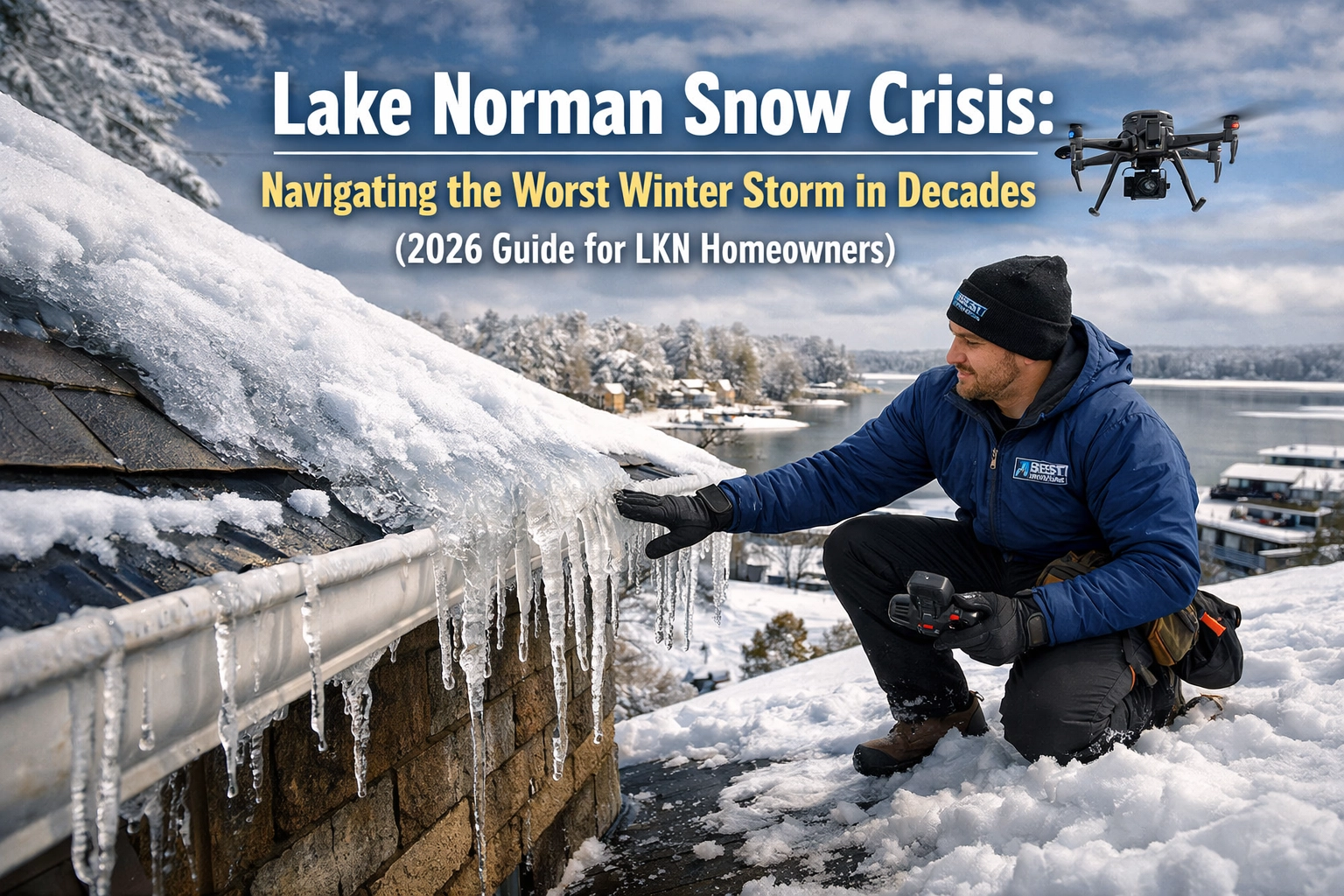
If you're reading this from Mooresville, Cornelius, Davidson, Huntersville, or Denver, you already know. This isn't your typical North Carolina dusting. We're in the middle of the worst winter storm Lake Norman has seen in decades, and your roof is carrying the weight of it.
Up to 9 inches of snow is forecast for our area through early February. That's not just a pretty postcard moment. That's hundreds of pounds of weight on your roof, moisture working its way into places it shouldn't be, and gutters that are about to show you exactly what they're made of.
I'm writing this because we live here too. Our trucks are out there. Our families are here. And we've already started getting calls from neighbors whose homes are showing signs of stress. This storm isn't over yet, but the damage clock has already started ticking.
Let me walk you through what makes Lake Norman homes especially vulnerable right now, and what you can do about it.
Living on or near the lake is beautiful 360 days a year. But during a storm like this? That proximity to water changes everything.
Higher wind exposure. If your home is anywhere near the shoreline or on a ridge with lake views, you're dealing with stronger, more consistent wind than properties tucked into neighborhoods farther inland. Wind doesn't just blow snow around. It drives moisture under shingles, lifts edges, and finds every weak point in your roof's armor.
Lake air + heavy snow = moisture penetration. Here's what most people don't realize: the air around Lake Norman carries more moisture than areas even 5 miles away. When you combine that humid lake air with heavy, wet snow sitting on your roof for days, you create the perfect recipe for leaks.
Snow melts slowly. It refreezes at night. Water works its way into flashings, valleys, and any spot where two roof planes meet. By the time you see a stain on your ceiling, water has been traveling through your roof deck for days, maybe weeks.
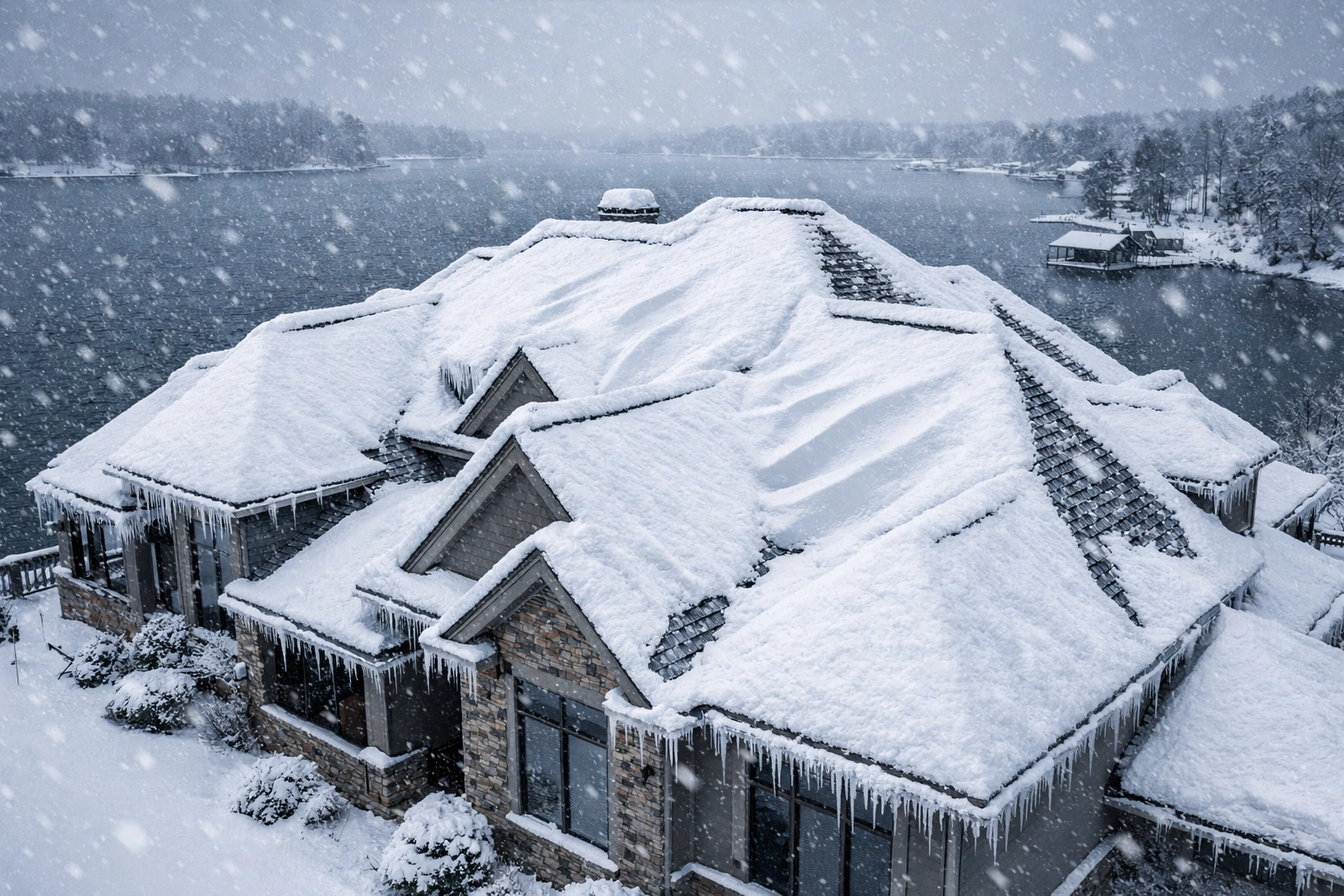
Your home wasn't built for this. Most Lake Norman homes were designed for our typical mild winters. A dusting of snow here and there. Maybe an inch or two that melts by noon. Not 9 inches that sticks around with nighttime temps dropping into the teens.
That means your roof might not have the same level of ice and water protection that homes in, say, upstate New York would have as standard. It doesn't make your roof bad. It just means it's being tested beyond what the builder planned for.
Let me break down what we're seeing in each area:
Mooresville – You're getting the full lake effect. Homes along the northern shoreline are dealing with wind-driven snow and exposed roof planes. We've already inspected three properties where snow drifted 18+ inches on the north-facing slopes.
Cornelius – Your peninsula location means wind from multiple directions. If you've got a complex roofline with multiple valleys, watch those areas closely. That's where water is pooling first.
Davidson – The historic homes in your downtown core weren't built with modern waterproofing standards. If your home was built before 1990, pay extra attention to your attic and any signs of moisture.
Huntersville – You're right in the transition zone between lake effects and inland conditions. The good news? Slightly less wind. The challenge? You're still getting the heavy, wet snow that's hardest on roof structures.
Denver – You're catching the tail end of lake moisture mixed with higher elevation. Ice dams are a bigger concern for you than the other towns. We'll talk about those in a minute.
Most homeowners think about roofs from the outside. Shingles. Gutters. What you can see from the street.
But the real story of this storm is happening inside your roof assembly. In your attic space. In the small gaps between your decking and underlayment.
Here's the process:
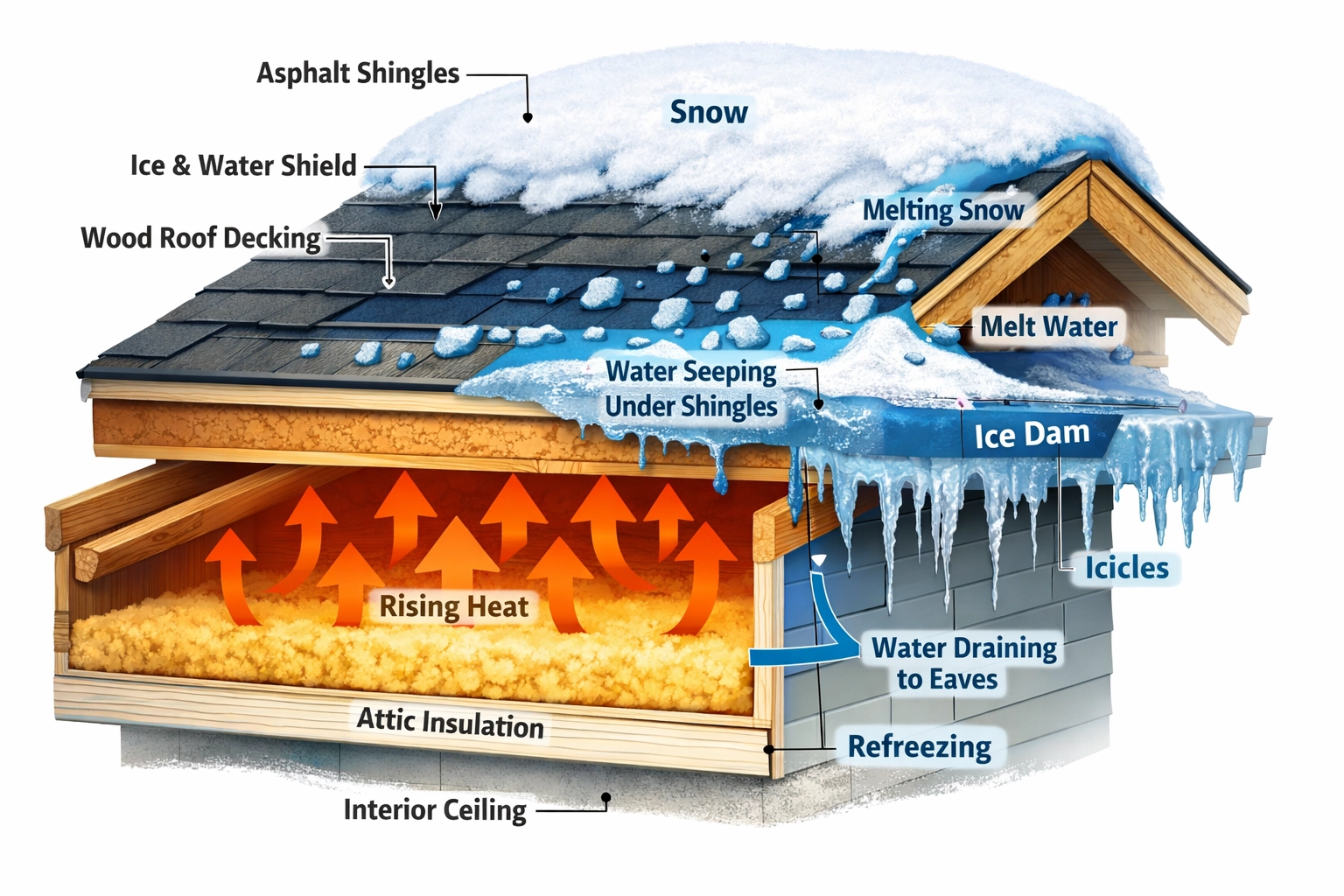
Step 1: Heavy snow lands on your roof. Weight starts to accumulate. A cubic foot of wet snow weighs about 12-20 pounds. Do the math on a 2,000 square foot roof plane with 6+ inches of snow, and you're looking at several thousand pounds of extra weight.
Step 2: Your home's heat rises into the attic (it always does, even with good insulation). That heat warms the underside of your roof deck. Snow starts melting from the bottom up.
Step 3: Melted snow turns into water. Water flows downward toward your gutters and eaves. But when it reaches the colder overhang of your roof (the part that extends past your heated home), it refreezes.
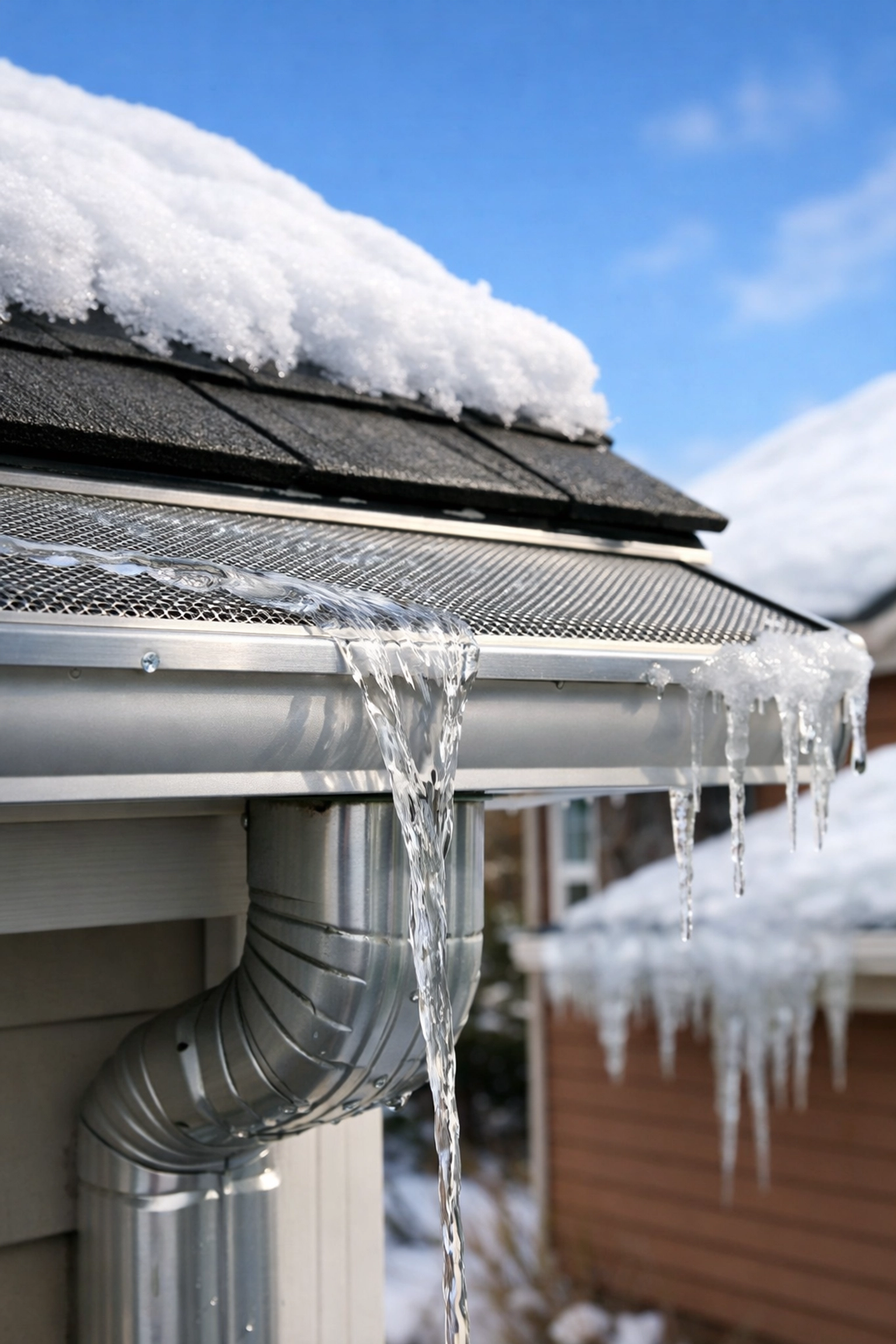
Step 4: Ice dam forms. New meltwater backs up behind the ice. Now you have standing water on your roof: something shingles were never designed to handle for extended periods.
Step 5: Water finds its way under shingles, through nail holes, into valleys, around flashings. By the time you notice a drip, that water has already traveled 10-15 feet through your roof assembly.
If I had to pick the #1 failure point during this storm, it's flashings and valleys.
Flashings are the metal pieces around your chimneys, skylights, dormers, and anywhere your roof meets a wall. They're sealed with caulk or roof cement. Both of those materials get brittle in extreme cold. When ice forms and expands, those seals break. Water walks right in.
Lake Norman homes have more complex rooflines than typical suburban houses. More architectural interest. More dormers. More angles. That means more flashings: and more potential failure points.
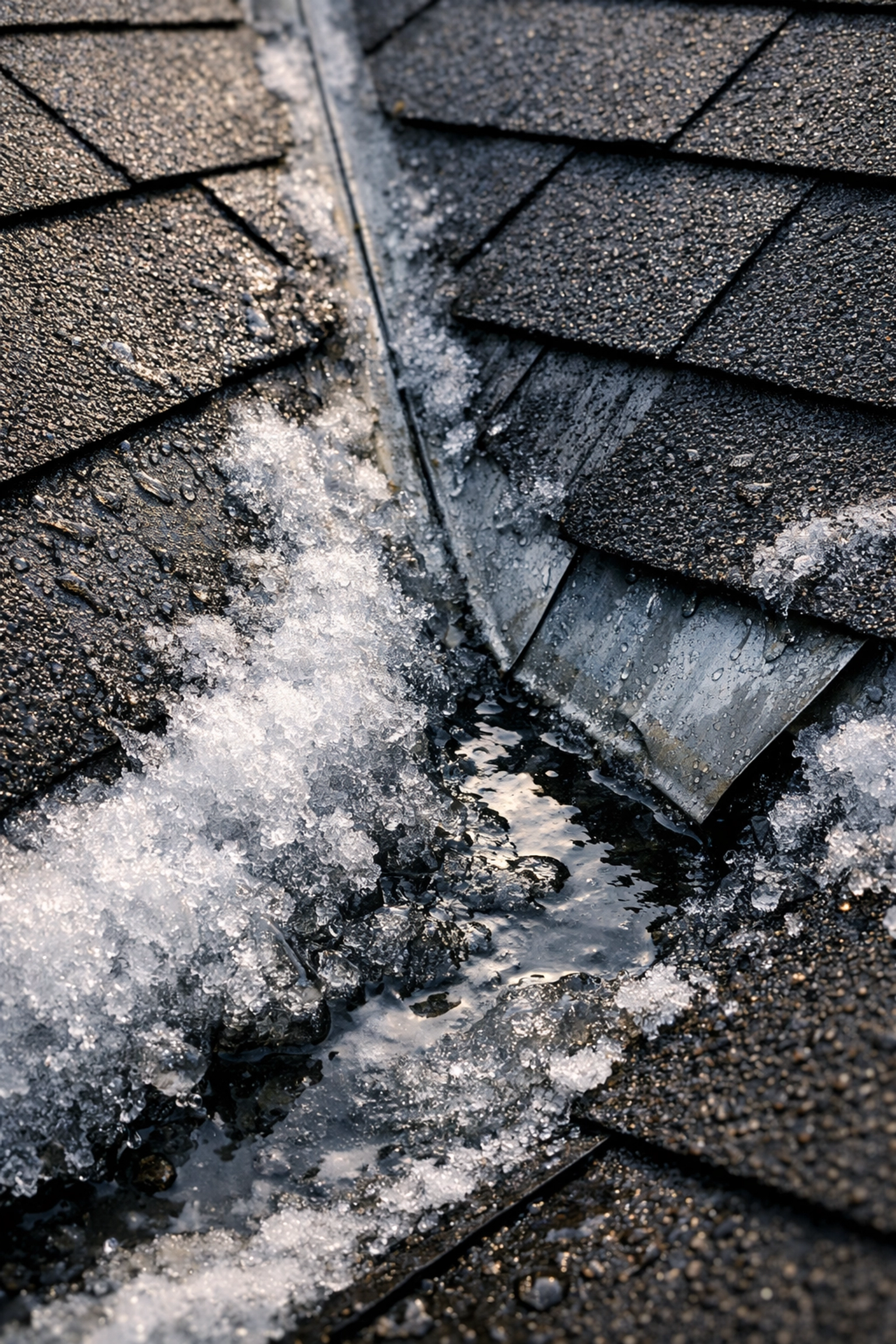
Valleys are where two roof planes meet and funnel water downward. In normal rain, they work perfectly. In heavy snow conditions with freeze-thaw cycles? They become ice channels. Water backs up. Shingles in valleys are especially vulnerable because they're cut and overlapped: not one continuous piece.
We've seen three valley leaks in Davidson just this week. All three homes had roofs under 10 years old. The roofs weren't bad. The conditions were just too extreme for standard installations.
Here's what to look for:
If you see any of these signs, don't wait. Water damage compounds fast. What's a $300 repair today becomes a $3,000 problem in two weeks.
I've got to give a shout-out to one of our longtime customers, Bo Gregory, who lives on a waterfront lot in Cornelius.
Bo called us three years ago about gutter guards. He was tired of cleaning gutters twice a year and dealing with clogs every time it rained. We installed a high-quality micro-mesh system on his entire home.
He called me two days ago. Not because he had a problem: because he wanted to tell us his gutters were handling the snow melt perfectly while his neighbor's gutters were overflowing and causing ice dams.
Here's why that matters:
Clogged gutters in winter = disaster. When gutters fill with ice and debris, water has nowhere to go. It backs up under your shingles. It creates ice dams. It drips down your siding and into your foundation.
Gutter guards keep water moving. Even in freezing conditions, quality gutter guards allow meltwater to flow through while blocking leaves and debris. Water that's moving doesn't freeze as easily as standing water.
The math works out. A full gutter guard system costs about the same as 3-4 years of professional cleaning. But during a storm like this? It could save you thousands in water damage repairs.
If you don't have gutter guards and you're noticing ice buildup or overflow right now, that's a conversation we need to have once this storm passes. The next big snow event could hit next winter: and you want to be ready.
I'm not going to tell you to get on your roof. Don't do that. Ice + ladders + frozen shingles = a trip to the ER.
But here's what you CAN do safely from the ground:
Walk your home's perimeter. Look for:
Check your attic if you have safe access. Look for:
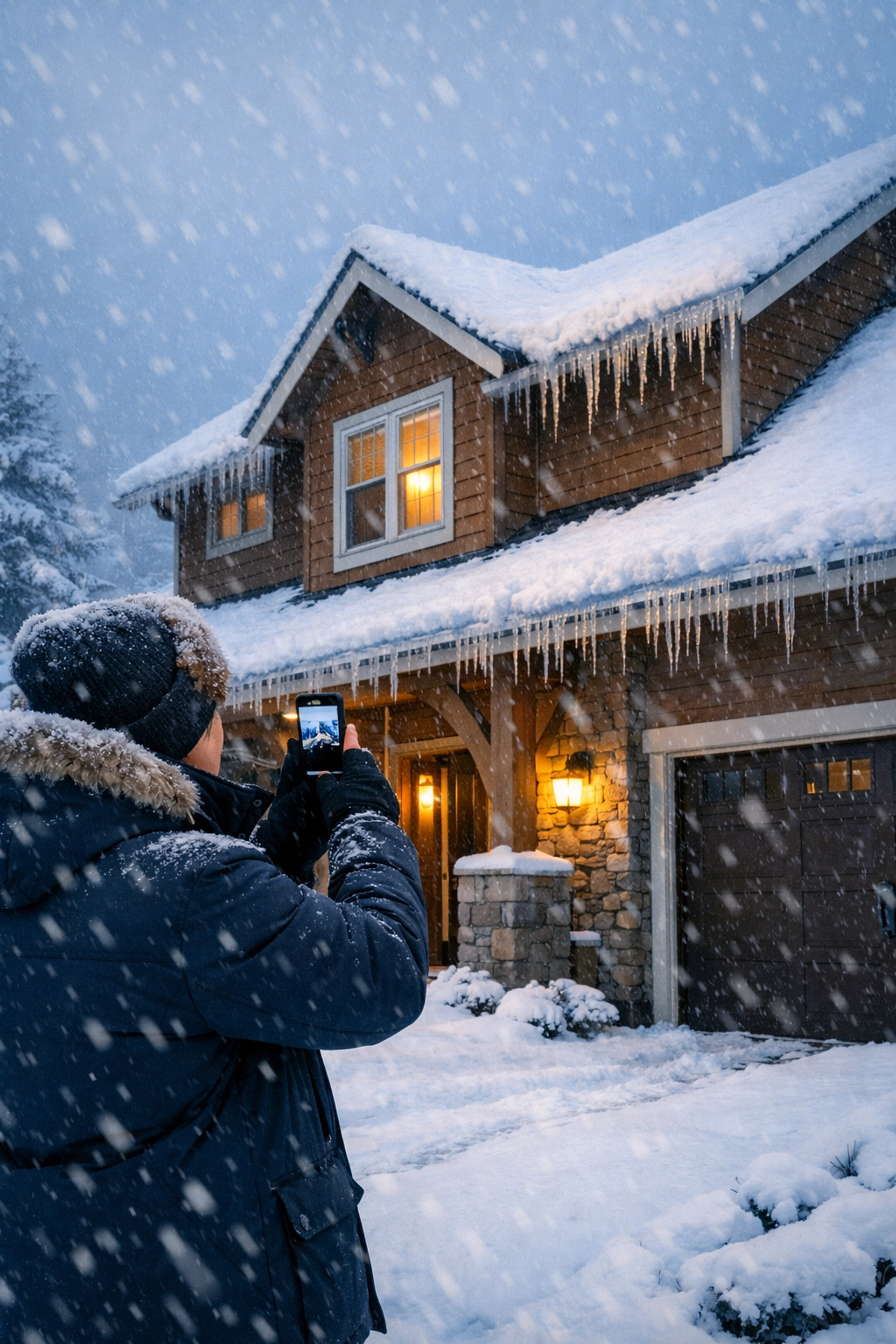
Document everything with photos. If you do end up with damage, your insurance company will want documentation. Take photos now showing the amount of snow, any ice dams forming, and any visible water infiltration.
Clear ground-level hazards. Move anything away from your foundation that could be damaged by ice or water. Outdoor furniture, grills, plants in pots: get them away from your dripline.
Keep downspouts clear. If you can safely access the bottom of your downspouts, make sure they're not blocked with ice. A blocked downspout means water will back up into your gutters and then into your roof.
Here's what NOT to do:
❌ Don't use a roof rake if you're not trained. You can damage shingles.
❌ Don't pour hot water on ice dams. Thermal shock can crack shingles.
❌ Don't chip away at ice with tools. You'll damage more than you fix.
❌ Don't ignore small leaks thinking they'll stop when it melts. Water damage continues even after the snow is gone.
You'll see that phrase on a lot of local business websites. For some companies, it's just marketing.
For us? It's Thursday afternoon and my truck is stuck in the same snow yours is.
My kids go to school with your kids. I buy groceries at the same Harris Teeter you do. When Lake Norman gets hit with something like this, we're not watching it on the news from some corporate office in another state. We're living it right alongside you.
That matters because:
We know your neighborhood. We've worked on homes in your subdivision. We know which builders cut corners. We know which developments used better materials. We know where the wind comes from and which roofs take the hardest beating.
We respond to our neighbors first. When the phone starts ringing with emergency calls, we prioritize based on need and proximity. Lake Norman residents aren't at the back of some corporate call queue. You're our community.
We understand lake property challenges. We've replaced roofs on waterfront homes for 15+ years. We know the building codes. We know the wind zones. We know what works and what fails when lake weather turns nasty.
We'll be here after the storm. The national chains and storm chasers will show up next week with temporary fixes and high-pressure sales tactics. We'll still be here in five years when your warranty matters and you need someone who remembers your home.
The forecast shows snow continuing through Sunday, with temps staying below freezing until Tuesday. That means:
Saturday-Sunday: Peak snow accumulation. Maximum roof loading. This is when structural issues would show themselves (extremely rare, but it happens).
Monday-Tuesday: First major melt cycle. Daytime temps above freezing, nighttime temps below. This is when ice dams form and leaks start showing up inside homes.
Wednesday-Thursday: Second melt cycle. Any leaks that started Monday will get worse. Water stains that were small become bigger. Drips become flows.
Next Weekend: Full assessment time. This is when we'll be able to get on roofs safely and see what damage occurred under all that snow.
If you're going to have a problem, it's most likely to show up Tuesday-Thursday next week. That's when our phone will be ringing nonstop.
Here's what I'm asking you to do: Don't wait until you have water dripping on your dining room table to call us. If you see ANY of the warning signs I mentioned earlier: ice dams, valley buildup, ceiling stains, attic moisture: reach out now.
I'm making this commitment public: Lake Norman residents who call us during this storm crisis will get priority scheduling for emergency assessments.
That means when you call, you're not going into some general queue behind everyone else in the Charlotte metro. You're getting flagged as a lake property with storm exposure, and we're routing trucks to your area first.
Why? Because lake homes face different challenges than inland properties. Because we know the difference between a routine snow event and what we're dealing with right now. And because when your neighbors are in trouble, you show up.
Here's how this works:
Call us at the number on our website. Tell them you're calling about storm damage assessment in the Lake Norman area. Mention this blog post if you want: that helps us route you correctly.
We'll ask you basic questions. Location, what you're seeing, whether you have active leaks or just concerns. This helps us prioritize based on severity.
We'll give you a realistic timeframe. If you have water actively coming in, we'll be there within 24 hours. If you're seeing warning signs but no active damage, we'll schedule you in the next 3-5 days as conditions allow.
We'll document everything. Photos, measurements, moisture readings. If you need to file an insurance claim, we'll give you exactly what your adjuster needs to see.
We'll give you honest recommendations. If your roof needs immediate emergency repair, we'll tell you. If it just needs monitoring for a few days, we'll tell you that too. We don't sell you services you don't need.
Every major storm teaches us something. Hurricane Hugo changed building codes. The 2014 ice storm changed how we think about tree management near homes.
This 2026 storm is going to change how we approach winter protection for Lake Norman roofs.
I predict we'll see:
More homeowners requesting upgraded ice and water protection during roof replacements: even though it's not required by code in our zone. Smart homeowners will realize that "code minimum" doesn't cut it when lake weather gets extreme.
Gutter guard installation will spike in the spring. People who watched their neighbors deal with ice dams while their own guards kept things flowing will make that investment.
Attic ventilation upgrades will become more common. Proper ventilation keeps attic temps closer to outdoor temps, reducing snow melt and ice dam formation.
Valley metal installations will replace traditional woven valleys in lake properties. Metal valleys shed water and ice better than shingle valleys.
We're already planning to offer a "Lake Norman Winter Protection Package" for roof replacements this spring. It'll include:
Because here's the truth: we're going to have more storms like this. Maybe not next year. Maybe not for five years. But they're coming.
Climate patterns are shifting. Lake Norman's popularity is growing. Home values are rising. And the gap between "good enough" and "built to last" is getting wider every year.
If you're reading this and you haven't seen any problems yet, that's good news. But don't assume you're in the clear.
This week: Monitor your home using the checklist I gave you earlier. Look for warning signs. Document anything unusual.
Next week: Schedule an assessment once conditions are safe. Even if you don't see obvious damage, a professional eye can spot issues before they become expensive problems.
This spring: Think about upgrades. If your roof is over 15 years old and you just watched it struggle through this storm, that's telling you something. Plan for a replacement before the next storm tests you again.
Next winter: Be prepared. Whether that's gutter guards, upgraded attic insulation, or just knowing who to call when snow starts falling, don't get caught off guard again.
If you're a Lake Norman homeowner dealing with this storm, here's what I want you to do:
Call us for a priority emergency assessment. We're at [phone number on website]. Tell them you're calling about the 2026 snow storm and you need a Lake Norman priority inspection.
Don't wait until you have major damage. Small leaks become big problems fast. Catching issues early means cheaper repairs and less stress.
Check out our storm damage resources. We've got detailed guides on what to do after a storm and how to tell if your roof needs emergency repair.
We're here. We're local. We're your neighbors.
And we're going to get through this storm together: one roof at a time. ✅
Stay safe out there, Lake Norman. We've got this.
Best Roofing Now
Charlotte's trusted roofing experts since 2019
Based on this article, you may be interested in these services.
We proudly serve these Charlotte-area communities with professional roofing services.
View All Service Areas →See our recent roofing work across the Charlotte metro area.
Charlotte, NC
new roof

Charlotte, NC
new roof
Charlotte, NC
new roof
Charlotte, NC
new roof
Get a free roof inspection and honest assessment from Charlotte's most trusted roofing company.


