
Roofing Tips & Guides
Expert Roofing Advice for Charlotte Homeowners
Learn from Charlotte's trusted roofing experts. Tips on maintenance, repair, replacement, and protecting your home from the elements.
Ice & Snow Damage? Get 10% off repairs with a free inspection.
Learn from Charlotte's trusted roofing experts. Tips on maintenance, repair, replacement, and protecting your home from the elements.
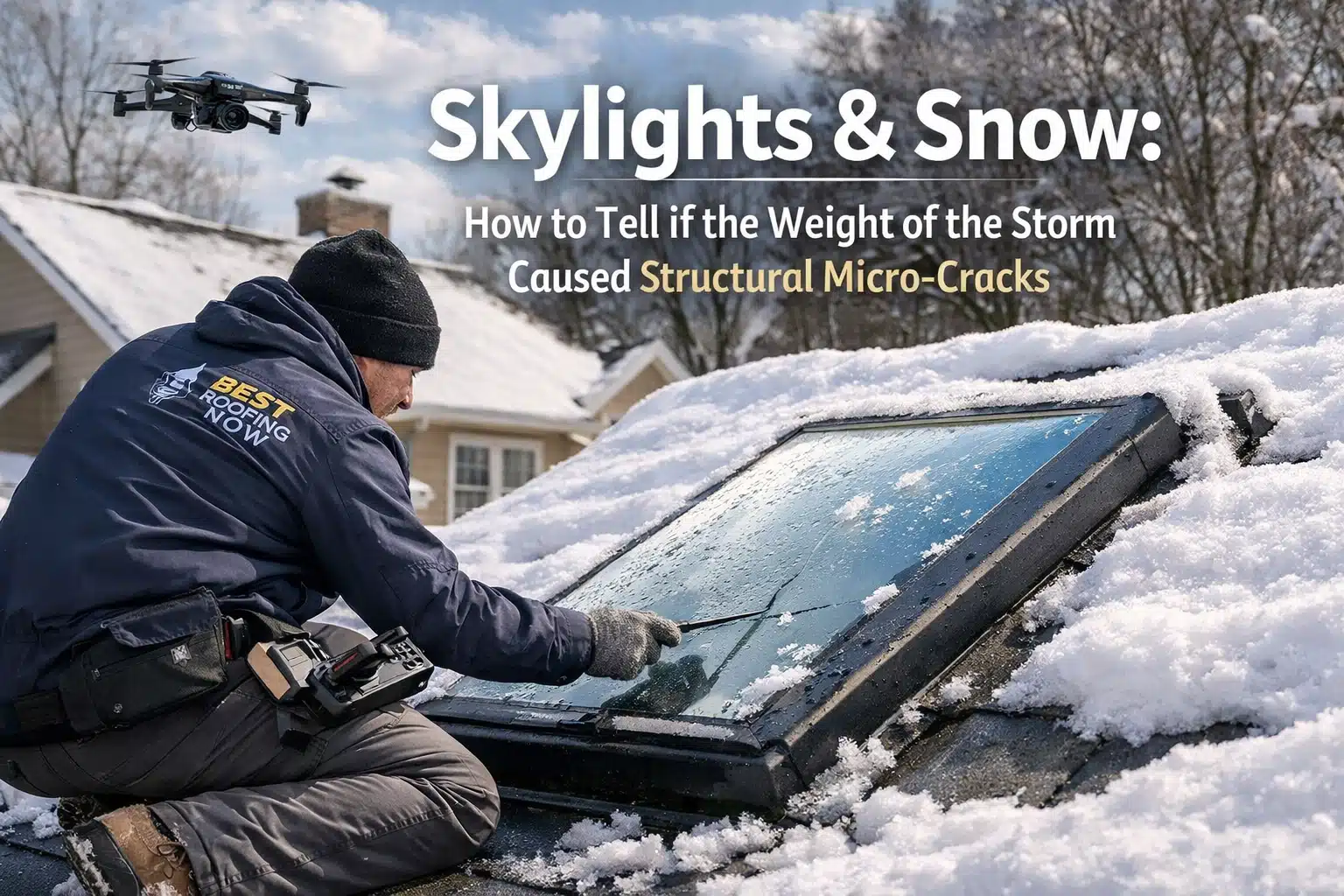
The 2026 snowstorm hit Charlotte and Lake Norman harder than anyone expected. We're talking about snow loads that roofs in our area just don't see very often. And while most of us worry about shingles and gutters after a storm like that, there's one part of your roof that deserves special attention: your skylights.
I've been inspecting roofs across Charlotte for years. After this latest snow dump, I've seen more skylight stress than I'd like to admit. The good news? Most of it is fixable if you catch it early. The bad news? Those tiny micro-cracks you can barely see today can turn into major leaks by April when the spring rains roll in.
Let me walk you through exactly what to look for and why it matters.
Here's the thing about skylights: they're basically windows lying flat on your roof. That means they take the full weight of whatever falls from the sky. No slope to help snow slide off. No protective overhang.
When we get a typical Charlotte winter with a few inches here and there, skylights handle it just fine. But when you pile on 18+ inches of heavy, wet snow like we just did? That's a different story.
The average square foot of wet snow can weigh between 12 and 20 pounds. A standard 2×4 foot skylight has eight square feet of surface area. Do the math, and you're looking at 96 to 160 pounds of weight pressing down on that glass and frame. For hours. Sometimes days.
Most skylights are designed to handle this kind of load. But "designed to handle" and "will definitely be fine" are two different things. Especially if your skylight is more than 10 years old or if it was installed with less-than-perfect technique.

Let's start with the obvious stuff. These are the signs you can spot from inside your home or from a safe vantage point outside.
Visible Cracks
The most straightforward warning sign is a crack you can actually see. Sometimes these are obvious, a clear line running across the glass. Other times, they're so faint you have to catch them in the right light.
Check your skylights on a bright day. Stand underneath and look up. Then go outside (when it's safe) and look down. You're searching for any lines, no matter how thin.
According to the National Roofing Contractors Association, "Even hairline cracks in skylight glazing can compromise waterproofing integrity and should be evaluated by a qualified professional within 30 days of discovery."
Spider Web Patterns
This is where things get interesting. Sometimes snow weight doesn't create one clean crack. Instead, it creates what we call a "spider web" pattern, multiple small cracks radiating out from a central point of stress.
These usually show up right where the weight was most concentrated. If snow piled up deeper on one side of your skylight, that's where you'll see the spider web.
Spider web patterns are serious. They mean the glass took a hit it couldn't quite handle. The structural integrity is compromised.
Cloudy or Distorted Glazing
This one's sneaky. If the glass looks foggy, milky, or wavy in spots where it used to be crystal clear, that's a red flag.
What you're seeing is one of two things: either the seal between double-pane glass has failed (letting moisture in), or the glass itself has been stressed to the point where it's starting to delaminate.
Both problems trace back to the same root cause: too much weight pushing down for too long.

Not all skylight damage is visible. Some of it announces itself in other ways.
Cracking or Popping Sounds
Did you hear your skylight "talk" during the storm? Creaking, cracking, or popping sounds coming from the area around your skylight mean the frame or glass was under serious stress.
I've had homeowners tell me they heard a sharp "crack" during the night and figured a tree branch hit the roof. When we inspected, it turned out to be the skylight frame giving way slightly under the snow load.
Even if the sound stopped after the snow melted, the damage might still be there. Frames can crack, shift, or separate from the roof deck without making noise after the initial event.
Trouble Opening or Closing
If you have an operable skylight (one that opens for ventilation), try opening and closing it now. Does it stick? Does it feel harder to move than it used to? Does it not close all the way?
These are signs that the frame has shifted. Snow weight can bow or twist a skylight frame just enough to throw off the alignment. You might not see the deformation with your eyes, but the mechanism will feel it.
Frame Bowing or Sagging
This requires a closer look, and I'll be honest, this is where you might want to call in a professional like us instead of climbing up yourself.
If you can safely inspect your skylight from outside, look at the frame from multiple angles. Does it look straight? Or does it bow inward slightly? Does one corner sit lower than the others?
Frame deformation is a big deal. It means the skylight's structural support system has been compromised. Even if the glass itself is fine, a bent frame will leak eventually.

Here's what keeps me up at night when I think about snow-damaged skylights: seal failures.
The seal around your skylight, the rubber gasket, flashing, and waterproof barrier that keeps water out, was designed for normal conditions. A little rain. Normal temperature swings. The occasional leaf pile.
It wasn't designed to be crushed under 150 pounds of snow and ice for three days straight.
When seals get compressed like that, they can develop tiny gaps or tears. You won't see water right away. The seal might hold during the next rainstorm. And the one after that.
But come April, when we get those heavy spring rains Charlotte is famous for, that's when the trouble starts. Meltwater backs up. Water finds the weak point. And suddenly you've got a drip in your ceiling.
By the time you see water damage, the problem has been brewing for months.
Signs Your Seal Might Be Compromised:
Let me explain why I'm so focused on micro-cracks specifically.
A big crack is obvious. You see it, you fix it. But a micro-crack, one you can barely see or maybe can't see at all, is dangerous because it's easy to ignore.
Here's what happens: water gets into that tiny crack. In North Carolina, our temperatures bounce around freezing all winter long. Water freezes at night. Ice expands. The crack gets bigger. Water melts during the day and goes deeper into the crack. Freezes again that night. Expands again.
It's called the freeze-thaw cycle, and it's brutal on skylights.
A micro-crack in February can become a major structural failure by March. I've seen it happen dozens of times.
The Building Science Corporation notes that "freeze-thaw cycling in building materials creates exponential damage patterns, with small initial cracks expanding at rates of up to 10% per cycle under optimal conditions."
That's a fancy way of saying: little cracks become big cracks fast.

Alright, you've read through the warning signs. Maybe you spotted something. Maybe you're just playing it safe. Either way, here's your action plan.
Step 1: Document Everything
Take photos. From inside and outside if you can do so safely. Date them. Write down what you see, hear, or feel.
If you end up filing an insurance claim, this documentation will be gold.
Step 2: Stop Further Damage
If you've got an obvious leak, put a bucket under it. If you can safely remove snow from around the skylight (without climbing on the roof yourself), do it. But be careful. Melting snow can refreeze at night and create dangerous ice patches.
Step 3: Call a Professional
This is where I recommend bringing in someone who knows skylights inside and out. We've done hundreds of skylight inspections across Charlotte and Lake Norman after storms.
We'll check:
Our inspections are thorough but fast. Most take less than an hour. And if we find damage, we'll walk you through your options: from simple seal replacement to full skylight replacement.
Step 4: Work With Your Insurance
If the damage is storm-related and significant, your homeowner's insurance might cover it. We work with insurance companies all the time. We can provide detailed reports, photos, and cost estimates to support your claim.
The key is acting fast. Most insurance policies have strict deadlines for reporting storm damage.
Let's talk about next winter. Because this won't be the last big snow Charlotte sees.
Regular Maintenance Matters
Most skylight problems start long before a snowstorm hits. Old seals. Cracked flashing. Loose mounting brackets. These issues might not cause leaks on a normal day, but they become critical when extreme weather arrives.
We recommend inspecting your skylights twice a year: spring and fall. Look for:
Consider an Upgrade
If your skylights are more than 15 years old, this might be the perfect time to upgrade to newer, stronger models.
Modern skylights are built with impact-resistant glass, reinforced frames, and better seal technology. They're designed to handle heavier loads than the skylights installed in the 90s or early 2000s.
Plus, new skylights are more energy-efficient. That means lower heating and cooling bills year-round.
Professional Installation Is Non-Negotiable
I can't stress this enough: skylight installation is not a DIY project. I've seen too many skylights fail because they were installed incorrectly in the first place.
Proper flashing. Correct mounting angles. Adequate structural support. These details make the difference between a skylight that lasts 25 years and one that leaks after the first snow.
When we install skylights, we follow manufacturer specs exactly. We reinforce the roof deck if needed. We use ice and water shield (a sticky waterproof barrier) under all the flashing. And we test everything before we leave.
Living in Charlotte or Lake Norman means dealing with weather that doesn't follow the rules. We can get 70-degree days in January and snow in March. That temperature swing is tough on skylights.
The freeze-thaw cycle I mentioned earlier? We get more of those cycles than almost anywhere else in North Carolina. Our winters aren't consistently cold. They bounce. And that bouncing is what really damages building materials.
Also, because heavy snow is relatively rare here, many older homes have skylights that were never designed for the kind of load we just experienced. They were spec'd for "typical" Charlotte winters. This wasn't a typical winter.
If you live near Lake Norman, you've got an extra factor: humidity. The moisture from the lake combined with temperature swings can accelerate seal degradation. Skylights in Lake Norman homes need extra attention.
Look, I could write about a dozen different roofing topics. But I'm spending time on this one because skylight damage is sneaky. It's easy to miss. And by the time most homeowners notice it, the repair bill has tripled.
We've built Best Roofing Now on a simple principle: educate first, sell second. If this article helps you spot a problem before it becomes a disaster, we've done our job. Even if you never call us.
That said, if you do need help: whether it's a free inspection, a repair, or a full replacement: we're here. We've earned our reputation across Charlotte and Lake Norman by being straight shooters who show up on time and do what we say we'll do.
No pressure. No gimmicks. Just honest roofing work from people who care about getting it right.
If you're reading this and thinking, "I should probably get my skylights checked," trust that instinct.
Here's what I recommend: schedule a free, no-pressure inspection with us in the next two weeks. We'll come out, take a thorough look at your skylights, and give you an honest assessment of what we find.
If everything looks good? Great. We'll give you some maintenance tips and send you on your way. If we spot damage? We'll walk you through your options and help you understand what needs to happen next.
You can reach us at Best Roofing Now or give us a call. We serve all of Charlotte and the Lake Norman area, and we can usually get someone out within a few days.
The 2026 snow is in the books. But the damage it caused might still be hiding on your roof. Let's find it before it finds you.
Stay dry out there. ✅
Best Roofing Now
Charlotte's trusted roofing experts since 2019
Based on this article, you may be interested in these services.
We proudly serve these Charlotte-area communities with professional roofing services.
View All Service Areas →See our recent roofing work across the Charlotte metro area.

Charlotte, NC
new roof

Charlotte, NC
new roof
Charlotte, NC
storm damage

Charlotte, NC
completed exterior
Get a free roof inspection and honest assessment from Charlotte's most trusted roofing company.


